


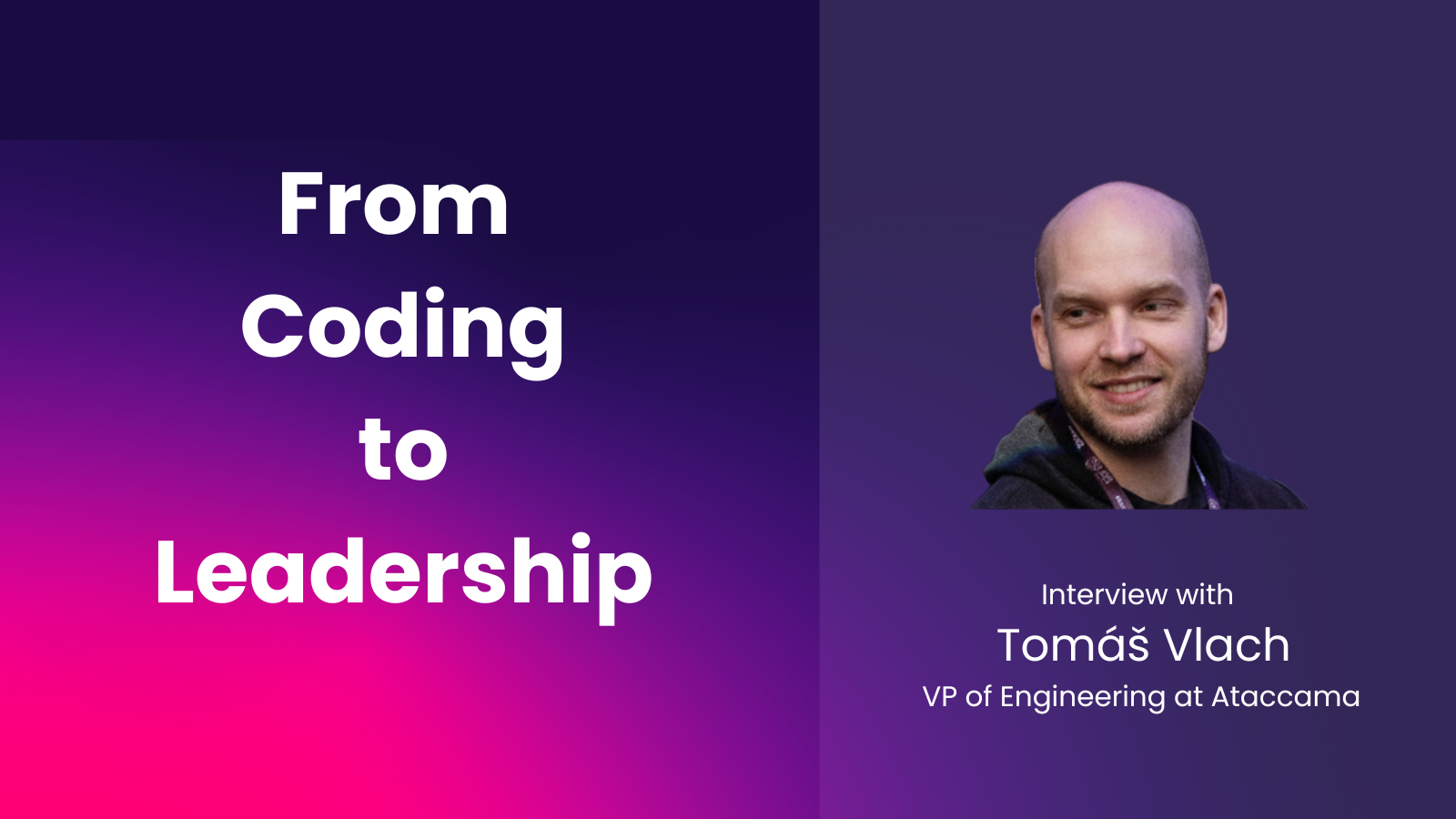

He has seen small teams grow into complex organisations, helped lone-wolf developers become high-performing teams, and learned that leadership has far less to do with code – and far more to do with people, trust and humility.
In this interview, Tomas shares how he went from writing code to shaping culture, what it means to lead in a fast-growing scale-up, and why he believes naivety can be a superpower.
“I thought I was ready for leadership. How naive I was.”
Q: Do you remember the moment when you first thought, “I want to be a leader”?
Tomas: I’ve always loved building things – writing code, dealing with distributed systems, networking, and the cloud. But over time I realised I didn’t just want to build systems; I wanted to work more with the people around those systems.
So I stepped out of my developer role, convinced I knew how to lead a dev team. I knew the tech, I knew the people and I thought: “How hard can it be?”
As it turns out – quite hard. And I’m glad I didn’t fully realise how hard before I started, because I might never have tried.
From Individual Contributor to Leader
Q: What was the biggest shock when you moved from developer to leader?
Tomas: The biggest surprise was that leadership is not an extension of coding.
It’s not about being the most senior engineer who now tells others what to do. It’s about listening more than talking, understanding people’s needs and making decisions that make sense for the company, not just the codebase.
You suddenly see that your impact is measured not only in features shipped, but in how people feel, collaborate and grow – and whether they can trust you.
Q: You’ve said that not everyone will like your decisions. How did you learn to live with that?
Tomas: In theory, I knew this from the start. In practice, it hits differently.
You make what you believe is the right decision, carefully weighing trade-offs. And then you see that some people are disappointed or even upset. That’s when it becomes emotional.
Leadership means accepting that you cannot please everyone – and that trying to do so would fail the team, the company and you.
Trust, Direction and Meaning
Q: Balancing trust and direction. What does that look like day to day?
Tomas It’s a constant balancing act.
On one side, I want teams to have real ownership: to decide, experiment and feel trusted. On the other side, we’re part of a wider organisation – if everyone runs in a different direction, we get chaos, not innovation.
So I keep moving between:
- Freedom: “You own this, you decide how to build it.”
- Clarity: “This is where we’re going and why it matters.”
On slides it looks simple. In reality, it’s a lot of listening, adjusting and sometimes admitting you misjudged it.
Q: What about motivating people? How do you bring that into your leadership?
Tomas: People don’t get truly motivated by tickets in a backlog. They need to understand:
- Why their work is important
- How it fits into the bigger picture
- And ideally, have a chance to work on things that genuinely excite them
One of the best parts of my job is trying to connect what people want to do with what the company needs to do. Sometimes there’s no perfect match and you have to be honest. But when it clicks, it’s a great feeling for everyone.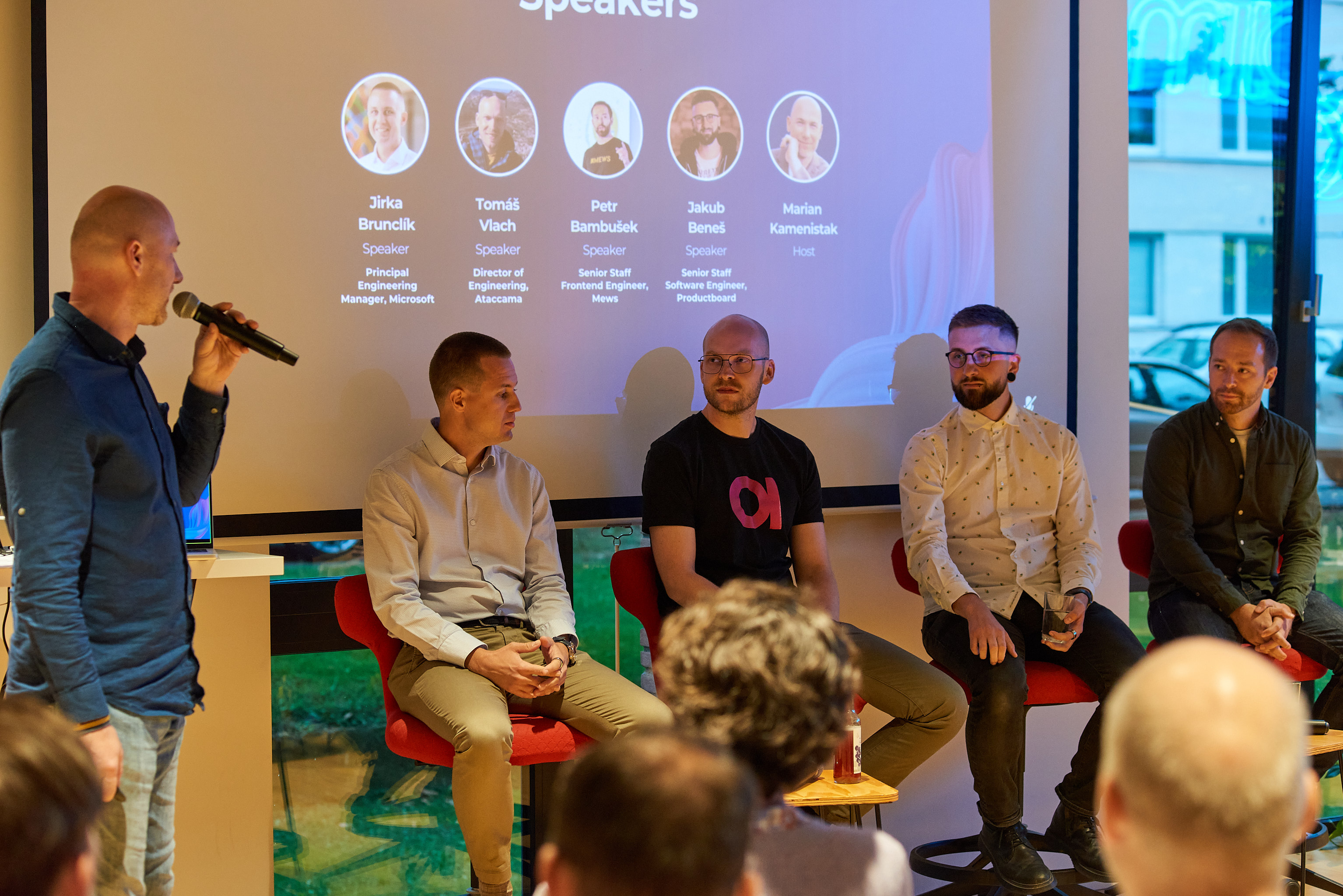
Tomas Vlach (in the middle) at Engineering Leaders Community meetup, talking about ownership
Why naivety is a superpower
Q: You call naivety a “gift”. Why?
Tomas: We often hear: “If I knew how hard this would be, I’d never have done it.” And that’s exactly the point!
If you saw every risk and difficulty upfront, you’d probably talk yourself out of most big decisions. Naivety lets you start. It lets you say: “I think I’m ready. Let’s do this.”
Then reality – and fear – show up once you’re already in motion. You discover how much you don’t know, but by then you’re in, committed and growing.
Without that initial naivety, I would have over-analysed everything and done nothing. We don’t grow by waiting until we’re perfectly ready. We grow by doing what we think we’re ready for – and then realising we weren’t. Yet.
Leading in a Scale-Up: Ataccama’s Sweet Spot
Q: You’ve worked in giants like Microsoft and Deloitte. What feels different about Ataccama right now?
Tomas: Ataccama is in a very special phase.
We’re no longer a tiny startup, but we’re far from a rigid corporation. We’ve grown from a Czech startup into an international company with hundreds of people across multiple hubs and countries.
Most startups never reach this stage. And those that do often struggle with the transition. We’re living it every day by:
- Adding just enough structure to the chaos
- Helping lone wolves become part of a pack
- Building guardrails that keep us safe without killing speed
It’s challenging – and it’s also a lot of fun.
Q: What makes leading here different from leading in a large, already stable organisation?
Tomas: In a big, established company, you usually inherit the system. Processes, rules, culture – they’re mostly defined. Your job is to operate within that frame.
In a scale-up like Ataccama, you’re often creating the system as you go.
You’re not a slave to senseless rules and admin – you help decide which rules make sense, how teams should work together and how we grow. There’s more ambiguity and sometimes more pain, but also much more impact. You’re not just following the playbook – you’re helping write it.
Community Over Co-Existence
Q: As organizations scale, the focus often shifts from structures to people. Would you agree that building strong communities becomes more important than relying on traditional functions or divisions?
Tomas: When I say the goal is to function as a community, not just co-exist, I mean that scaling up isn’t about rigid Functions or divisions—it’s about people choosing to collaborate because they trust each other and care about the shared outcome.
For me, it comes down to a few basics:
-
Trust – without it, people hide problems or play politics.
-
Humility – knowing you don’t have all the answers.
-
Respect – especially when you disagree.
-
Empathy – understanding where others are coming from.
Without these, communication breaks down and you lose ideas, knowledge, and dedication.
Leading in this phase often means stepping aside from your ego. Maybe your idea won’t be the one we choose—and that’s okay if the team and company move forward in a better way. And on the topic of ego: that’s a never-ending battle for me. I would love to say I am “past my ego” or something fancy like that, but it’s a constant struggle to keep it in check in a healthy way.
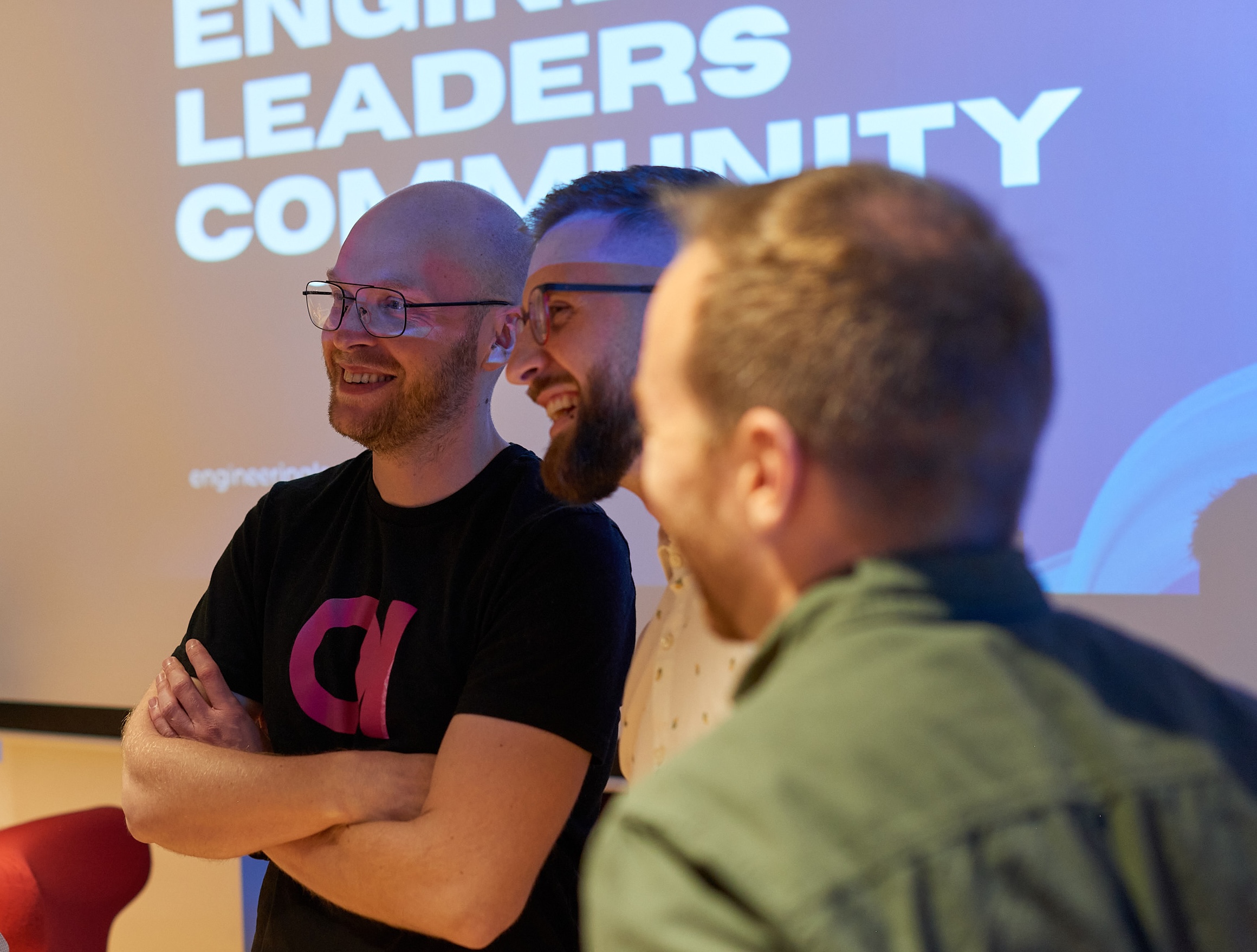
Tomas Vlach at Engineering Leaders Community meetup, talking about ownership
From Systems to Teams
Q: Do you still feel like a “builder”?
Tomas: Absolutely – I just build different things now.
Instead of only designing software systems, I’m helping build teams, culture and collaboration systems. The mindset is similar:
- You debug processes
- You design structures
- You iterate on how teams work
- You look at the “interfaces” between teams and functions
The difference is that people aren’t deterministic. You can’t just “restart” them, or expect two people to react the same way. You need patience, empathy and a willingness to adapt your own style, not just ask everyone else to adapt to you.
Planets, Data Catalogues and AI
Q: How is the Ataccama engineering team organised? Could you please explain the “planet” metaphor we use here at Ataccama – what does that mean, and what’s your planet?
Tomas: We like to think of our engineering organisation as a small galaxy of planets. Each “planet” represents a core product area with its own mission, team and roadmap – but all orbit around the same sun: trusted data for AI. In practice, our planet structure is a bit more nuanced than that - not every planet is a clearly independent domain, and we try to align teams to planets also based on how “close” various teams are in terms of dependencies, roadmaps, and so on.
My planet is the Data Catalog – the place where companies understand what data they have, where it comes from and whether they can trust it. On top of that, my planet also focuses on application platform aspects, and also on complex data processing topics and data lineage domain.
This ties directly into our latest release of the Ataccama ONE Agentic platform. We’ve introduced the ONE AI Agent, a kind of “data worker” that automates data quality tasks end to end and prepares reliable inputs for AI much faster. And with the Ataccama MCP Server, we can securely connect that governed, validated data to AI tools like ChatGPT or Claude and to customers’ own AI systems.
In simple terms: our product makes sure the data is findable, understandable and trustworthy, so that everything built on top – analytics, AI assistants, large language models – stands on solid ground. Reliable data is the foundation. Without it, AI is just guessing in a pretty interface.
Inspired to work with Tomáš? Take a look at our current openings in Engineering.